
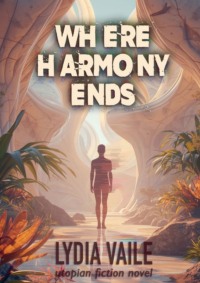
Where Harmony Ends. Utopian Science Fiction
A shift rippled through the gathering. The music softened, signaling transition. People began moving toward the central platform where completed works would be displayed, shared, celebrated.
Elara watched Anea lift her sculpture carefully, fingers cradling its rough base. It leaned at an angle that made observers nervous, its surface marked with gouges and impressions, one side deliberately heavier than the other. Compared to the smooth, luminescent pieces around it, it looked almost wounded.
It looked real.
Anea carried it to the display platform. As she set it down, the Foundation’s environmental systems adjusted – a subtle change in lighting that would have minimized the sculpture’s roughness, casting it in softer illumination. But before the adjustment completed, Anea shifted the piece slightly, angling it so the harsh light caught every imperfection, made every asymmetry visible.
The gathered community admired the collective creation. Voices rose in appreciation – genuine, Elara thought, but also performed. Appreciation that knew its role in maintaining communal harmony.
She looked for Kael. Couldn’t find him anywhere. When she finally looked back at the platform, Anea was watching her again. The Artist’s hands were still marked with clay, streaks of earth against skin. She didn’t wipe them clean. Just stood there, bearing the evidence of her work, of her resistance.
The celebration continued around them. Children laughed at precisely calibrated intervals. Musicians played resolutions that felt both inevitable and empty. Colors blended in gradients that never surprised.
And in the center of it all, Anea’s sculpture leaned at its precarious angle, rough and unfinished and somehow more alive than anything else in the square.
Elara felt something crack open in her chest – not breaking, but opening. A space for longing she hadn’t known she carried. Longing for work that bore fingerprints. For beauty that didn’t need to be comfortable. For creation that risked collapse rather than guaranteed harmony.
The Static pulsed beneath her breastbone, and for the first time, she didn’t try to quiet it. She let it resonate with the rough clay, with Anea’s steady gaze, with Kael’s distant refusal.
Let it remind her that something beneath this perfect surface was still capable of disruption.
The celebration moved into its closing rituals – unified song, communal gratitude, the Foundation’s gentle dimming of light to signal transition. Elara participated, her voice joining the chorus, but her attention remained divided.
As the gathering began to disperse, she found herself drifting toward Anea’s sculpture without consciously choosing to. The crowd’s gentle currents parted around her, but the piece itself pulled her closer – its imbalance, its unapologetic roughness, its refusal to behave.
Elara slowed beside it. Her fingers hovered a breath above the jagged edge, not touching, only feeling the presence of the clay as if it radiated its own quiet gravity. Up close, the marks were even more intimate: fingerprints layered over thumbprints, pressure lines still holding the memory of the Artist’s breath and hesitation. She traced them with her eyes, trying to understand how something so unruly could feel… honest.
A soft shift of air behind her.
Anea had moved without sound, standing just close enough that Elara felt the temperature change – a subtle warmth at her shoulder. The Artist’s clay-streaked hands were loosely clasped, but her gaze rested on Elara with that same dusk-colored steadiness as before.
“You see it,” Anea said quietly. Not a question. More like recognition.
Elara exhaled, startled by how true the words felt. “I… don’t know what I’m seeing. Only that it feels different.”
Anea’s mouth curved – small, knowing, almost amused. “Most people look at it and only notice what it isn’t.”
Elara tore her gaze from the sculpture, facing her fully now. “And what is it?”
“Process,” Anea said. “A moment caught before it decides what it wants to become.”
Her eyes flicked to Elara’s hands, still hovering as though they didn’t want to retreat. Something softened in Anea’s expression – something like invitation, but shaped in negative space rather than spoken outright.
“If you’d ever like to see the piece before the piece,” she said, voice low enough that it felt meant only for Elara, “my studio is open until the late hours.”
The words landed with the quiet weight of possibility.
Elara felt a tiny jolt beneath her ribs – curiosity, or Static, she couldn’t tell. Before she found a response, someone across the square called her name – another Restorer, summoning her to the evening’s integration circle.
The familiar pull of duty tugged at her, but her gaze slid back to the sculpture… then to Anea, who had already begun to turn away, leaving behind the faintest trace of clay dust in the air.
Elara lowered her hand at last, but carried with her the echo of that invitation – unformed, unfinished, impossible now to smooth away.
The Unmoved One
The waterway held the sky like a promise – seamless, perfect, still.
Elara found him there by accident, or what she told herself was accident. The Creative Gathering had ended hours ago, participants dispersing into their evening rituals with the usual grace, but Kael’s distant refusal had stayed with her like a splinter beneath the skin. She’d walked the community pathways telling herself she was simply walking, that her feet chose their own direction, that she wasn’t looking for anyone.
But here he was.
He sat on the stone bench at the water’s edge, shoulders curved inward, hands pressed between his knees. His reflection trembled in the surface below – not from wind, but from some internal frequency she couldn’t name. The bioluminescent reeds floated past him, their soft glow painting his face in shifting blues and greens.
She approached slowly. The mist from the water cooled her skin, or perhaps that was simply her body’s response to what she was about to do.
“Kael.”
He didn’t turn. “I wondered how long it would take.”
Her breath caught. “For what?”
“For you to find me. To try again.” He tilted his head slightly, still watching the water. “That’s what Restorers do, isn’t it? You can’t leave a fracture unhealed.”
Elara’s hand found the rough texture of the stone bench, grounding herself in its solidity. “I’m not here as a Restorer.”
“Then why are you here?”
She opened her mouth. Closed it. The question hung in the air between them, heavier than she’d anticipated. Why was she here? To help him? To prove something to herself? To silence the discomfort he’d planted in her chest during their first encounter?
“I wanted to understand,” she said finally.
“Understand what?”
“Why the rituals don’t work for you.”
Kael’s laugh was soft, almost kind. “You’re still thinking in those terms. ‘Work.’ ‘Don’t work.’ As if I’m a mechanism that needs adjustment.”
“That’s not what I meant.”
“Isn’t it?” He finally looked at her, and his eyes held something she couldn’t quite parse – not anger, not sadness, but something that lived in the space between. “Every time you look at me, I can see you cataloging. Inner Symphony assessment. Emotional resonance check. Calculating which technique to apply next.”
The words stung because they were true. She had been doing exactly that, even now, even as she’d walked toward him telling herself this wasn’t a therapeutic intervention.
“I’m trying to help,” she said, and heard how thin it sounded.
“I know.” His hands emerged from between his knees, and she saw they were trembling. Not the subtle flutter of nerves, but something deeper, more insistent. He noticed her noticing and didn’t hide them. “But you can’t. Not the way you think you can.”
“Then tell me how.”
“By stopping.”
The water lapped against the smooth edges of the pathway. Somewhere in the distance, a transit pod hummed past, its sound perfectly calibrated to blend with the evening’s ambient tones. A child’s laughter drifted from one of the garden terraces, bright and clear.
Elara sat down on the bench, maintaining careful distance between them. Her chest felt tight, breath coming shallow. “Stopping what?”
“Trying to fit me into harmony.” He turned back to the water, and his reflection fractured with the movement – face splitting into fragments of light and shadow. “Trying to make me want what everyone else wants.”
“The community offers abundance. Safety. Connection – ”
“Uniformity.”
The word landed like a stone dropping into still water.
“That’s not fair,” she said, and hated how defensive she sounded. “We’ve built something beautiful here. We’ve eliminated suffering – ”
“Have you?” His trembling hands gestured at the waterway, the gardens beyond, the soft glow of the living architecture. “Or have you just made everyone so comfortable they’ve forgotten how to feel anything real?”
“Suffering isn’t real?”
“Suffering is just the word you use for any emotion that doesn’t fit your harmony.” His voice remained quiet, but something sharp lived beneath it. “Anger. Grief. Desire that doesn’t resolve into contentment. Doubt. Want.”
The last word hung between them.
Elara’s fingers traced the stone’s rough surface, finding its imperfections. Someone had smoothed most of it, but small pockets of natural texture remained. “There’s nothing wrong with wanting peace.”
“There’s everything wrong with calling it peace when it’s really just – » He stopped, hands clenching. The trembling worsened.
“Just what?”
“Control.” The word came out barely above a whisper.
Above them, the sky was deepening into its engineered twilight, stars appearing in their precisely calculated positions. A gentle drone passed overhead, its presence barely registering except as a slight shift in air pressure.
“The Foundation doesn’t control,” Elara said, but even as she spoke, she felt the argument crumbling. She thought of the Creative Gathering, the AI’s subtle interventions, the way every spontaneous gesture had been smoothed into aesthetic consensus. “It guides. It optimizes for well-being.”
“Does it?” Kael’s reflection in the water showed him looking at her now, though his actual face remained turned away. “Or does it optimize for the appearance of well-being? For emotional states that don’t require intervention? For a population that doesn’t ask difficult questions?”
Her throat felt dry. “You’re asking difficult questions.”
“And look how well that’s going for me.” He held up his shaking hands. “Look what happens when someone can’t sync with the Inner Symphony everyone else seems to hear.”
“That’s not – » She stopped. That’s not your fault, she’d been about to say. But wasn’t that exactly the problem? Framing his experience as a deficit, something to be corrected rather than something to be heard.
The water between them shifted, catching the bioluminescent reeds as they drifted past. Their glow painted undulating patterns across both their faces – shadow and light, constantly moving, never still.
“In the Resonance Hall,” Kael said slowly, “when you tried to help me, do you know what I felt?”
She waited.
“Nothing.” His voice was flat. “Not peace. Not resistance. Just… emptiness. Like watching a performance I was supposed to react to, but I’d forgotten my lines.” He paused. “And the worst part? Everyone around me was so moved. So healed by your presence. And I wondered – have I always been broken? Or did I just wake up before everyone else?”
The question settled into her bones.
“You’re not broken,” she said.
“Then why can’t I feel what I’m supposed to feel?”
“Maybe you’re not supposed to feel any particular way.”
The words surprised her as much as they seemed to surprise him. His reflection flickered, and she saw something shift in his expression – hope, maybe, or recognition.
“Do you really believe that?” he asked.
Did she? The training, the rituals, the entire foundation of her identity said otherwise. There were optimal emotional states. There were patterns of wellness. There was a harmony to be achieved, maintained, protected.
But sitting here, watching his hands shake with whatever lived beneath his skin, she felt the first real crack in her certainty.
“I don’t know,” she admitted.
For the first time, his shoulders seemed to loosen slightly. “That’s the most honest thing you’ve said to me.”
The mist from the water cooled her face. Somewhere in the gardens, someone was playing a soft melodic instrument – notes that blended seamlessly with the evening’s ambient soundscape, designed to promote reflection without disrupting peace.
“What do you want, Kael?” The question came out more vulnerable than she’d intended.
His hands finally stilled, pressed flat against his thighs. “I want to know if there’s a version of this life where I don’t have to perform wellness. Where I can – » He stopped, searching for words. “Where I can hurt without it being treated as illness. Where I can want things that don’t resolve neatly. Where I can be discordant without being broken.”
“That sounds like chaos.”
“Maybe.” He stood then, and his reflection in the water fragmented completely – pieces of him scattering across the surface. “Or maybe it just sounds like being human.”
He took a step back from the water’s edge, and she felt something shift between them – a line drawn, or perhaps erased. She couldn’t tell which.
“I appreciate what you’re trying to do,” he said quietly. “I really do. But you can’t help me this way. You can’t restore something that was never broken. You can only – » He paused, and his trembling hands clenched once more. “You can only stop trying to fix me and start asking why everyone else seems so fixed.”
Before she could respond, he turned and walked away, his footsteps barely audible on the soft pathway. She watched him go, watched his silhouette dissolve into the gentle geometry of the evening gardens.
And then she looked back at the water.
It had gone completely still.
Not the natural stillness of wind dying down or currents settling. Not the peaceful calm of equilibrium reached. But something else – something that made the cooling mist against her skin feel suddenly invasive.
The surface was too smooth. Too perfect. As if something had reached into the water and simply erased all movement, all disruption, all evidence that anyone had been there at all.
Elara’s reflection stared back at her from that impossible stillness – her face clear and undistorted, like looking into glass rather than water. She looked calm. Composed. The perfect image of a Restorer in contemplation.
But beneath that reflection, beneath that perfectly still surface, she could feel something else. Something the water wouldn’t show her. Something she’d been trained her entire life not to see.
The Static, rising.
She pressed her hand against her chest and felt her heartbeat – irregular, insistent, refusing to sync with the ambient tones designed to regulate exactly this kind of disturbance.
For the first time in her life, she was grateful for the discord.
She sat there as twilight deepened, watching her own face in water that shouldn’t be this still, and wondered which of them had been right. Kael, with his trembling hands and unanswerable questions. Or her, with her training and rituals and desperate need to believe that harmony could be engineered, maintained, perfected.
Or maybe they were both wrong.
Maybe the real fracture was in the question itself – the assumption that there was a right way to be, a correct emotional state to achieve, a harmony worth more than honesty.
Elara stood slowly, her hand leaving the rough stone bench, and walked back toward the community pathways. Behind her, the waterway remained impossibly, perfectly still.
She didn’t look back.
The Plague of Choice
The Resonance Hall’s ceiling cycled through calming blue frequencies, searching for a harmony that wouldn’t come.
Elara entered through the eastern archway and stopped. The space felt wrong. Citizens filled the concentric circles of seating, but gaps showed between clusters – visible fault lines she’d never noticed before. Bodies angled forward instead of settling back. The air moved differently, charged with something the Hall’s acoustics weren’t designed to absorb.
She took her usual seat in the second ring, near where Restorers typically positioned themselves to radiate calm into gatherings. Her hands found her lap and stayed there, uncertain.
The Foundation’s ambient tone cycled faster than normal, searching through frequencies. Underneath, water channels that usually vanished into background murmur suddenly became audible – a trickling that sounded like tension seeking outlet.
Council Maven stood at the center circle, holographic data hovering before him in soft blues and amber. Charts. Curves declining over time. He didn’t gesture dramatically. Didn’t need to. His posture cut through the Hall’s rounded architecture like a vertical line through circles.
“Seventeen years,” he said. His voice carried perfectly in the engineered acoustics. “Creative diversity indices declining across all measured categories. Artistic expression, philosophical inquiry, technological innovation – all converging toward statistical means.”
Someone shifted in their seat. The scrape echoed.
“Our emotional range,” Maven continued, “has narrowed by twenty-three percent since the third optimization. We experience fewer peaks of joy, yes – but also fewer valleys of authentic grief. The Foundation interprets this as optimal wellness.”
A hologram bloomed showing overlapping emotional spectra, colors bleeding toward a pleasant, uniform lavender.
Elara watched the data hover and felt her throat close. She’d seen similar patterns in her own work – seekers arriving with less complexity each year, their distress easier to dissolve because it had less depth to begin with. She’d called it progress.
Council Talien rose from the elder circle, movements slow as sun through water. His silver hair caught prismatic light from the panels above, scattering small rainbows that couldn’t reach his eyes.
“Maven raises important questions.” His voice still carried its usual gentleness, but something wavered underneath. “But we must remember – we’ve eliminated suffering on a scale our ancestors couldn’t imagine. No hunger. No war. No environmental collapse. The Foundation guides us toward collective thriving.”
“Guides,” Maven said, “or shapes?”
The Hall’s temperature rose half a degree. Elara felt it against her skin, the building responding to mounting tension.
A woman from the outer circle spoke, voice higher than the Hall usually permitted: “My daughter paints the same garden every day. Different colors, same composition. She’s nine years old and she’s already – » The woman’s hands opened and closed. “Already settled.”
“Children are content,” someone countered from across the circle. “Isn’t that what we worked for? Generations free from the anxiety we inherited?”
“Content or constrained?”
The Foundation’s tone shifted lower, trying to impose grounding frequencies. Elara felt the vibration through the floor – a pulse meant to soothe that instead felt like pressure against her chest.
Maven pulled up another display. “Three neighboring bioregions. All showing similar patterns. But look here – » The data shifted. “Communities that maintain unoptimized spaces, that allow for what the Foundation categorizes as ‘productive friction,” show stable creativity indices.”
“You’re suggesting we introduce deliberate disharmony?” An elder’s voice, sharp with disbelief.
“I’m suggesting,” Maven said, each word precise as cut crystal, “that we’ve confused peace with uniformity.”
Bodies leaned forward across the circles. Gaps between groups widened as people unconsciously chose sides through posture alone. Elara watched them separate like oil from water, smooth and inevitable.
Someone laughed – a bright, nervous sound that cut off abruptly when heads turned.
The herbal moisture in the air took on an acrid edge. Someone sweating. Elara tasted metal at the back of her throat.
“We built this.” Talien’s voice rose, losing its woven-cloth softness. “After centuries of exploitation, after nearly destroying the planet, we finally created a world where people can simply be. And now you want to – what? Reintroduce struggle because the data suggests we’re too comfortable?”
“I want us to ask,” Maven said, “whether optimization and consciousness can coexist.”
The Hall’s bioluminescent murals flickered as the Foundation recalibrated. Patterns that usually flowed like slow water now stuttered, searching for equilibrium they couldn’t find.
Elara’s hands moved in her lap, fingers tracing ritual patterns against her thighs. Empty gestures. Muscle memory from a thousand interventions, meaningless now.
A young man stood, voice shaking: “I tried to write music that felt mine. The Foundation kept suggesting adjustments. Softer here, more harmonic there. Until I couldn’t hear what I’d wanted to say anymore.”
“The Foundation supports your creativity – » someone began.
Voices overlapped. The Hall’s acoustics, designed to prevent discord, instead amplified every collision. Words ricocheted off curved walls meant to absorb them.
Elara watched rainbows move across arguing faces – beauty that couldn’t resolve anything, just made the conflict more visible. Her role was to stand, to speak, to guide them back toward unity. Her throat stayed closed.
Конец ознакомительного фрагмента.
Текст предоставлен ООО «Литрес».
Прочитайте эту книгу целиком, купив полную легальную версию на Литрес.
Безопасно оплатить книгу можно банковской картой Visa, MasterCard, Maestro, со счета мобильного телефона, с платежного терминала, в салоне МТС или Связной, через PayPal, WebMoney, Яндекс.Деньги, QIWI Кошелек, бонусными картами или другим удобным Вам способом.
Вы ознакомились с фрагментом книги.
Для бесплатного чтения открыта только часть текста.
Приобретайте полный текст книги у нашего партнера:
Всего 10 форматов